
When Identity Becomes the Weapon: The Collapse of the Modern Trust Boundary
Caduceus Security Group | Intelligence Briefing
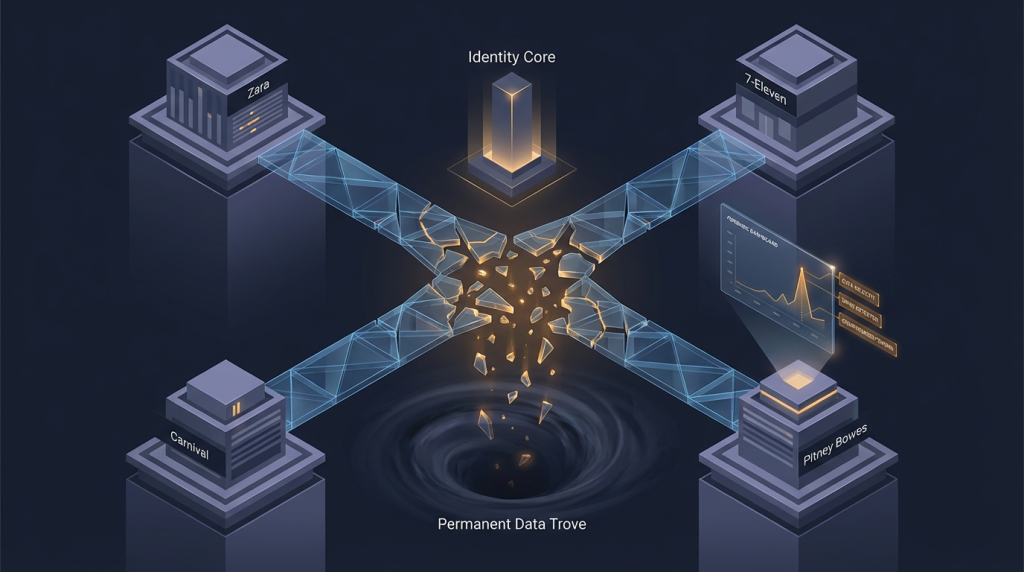
The recent wave of exfiltrations attributed to the ShinyHunters threat collective is being reported as a standard data breach story. It is not. It is an infrastructure story — and the distinction matters enormously for how organizations respond, investigate, and ultimately defend themselves.
With over 38 million records exposed across 40+ global organizations, the shift is no longer just about the volume of data taken. The threat group has stated that this data will stay online indefinitely; there is no “pay-to-delete” cycle. This is a transition into a permanent “Active Threat” state.
This Was Not a Series of Breaches. It Was a Pattern.
The temptation is to treat the 40 victim organizations — including Zara, 7-Eleven, and Carnival — as separate incidents. However, the intelligence points to a coordinated exploitation of a specific architectural weakness: the identity-to-infrastructure bridge.
This is the trusted connection between an organization’s core environment and the third-party services it utilizes. We see three primary clusters in this campaign:
1. The Analytics Bridge. Organizations are often compromised through trusted AI or analytics partners. Attackers don’t break the perimeter; they utilize service account permissions legitimately granted to a partner, then pivot to drain internal data stores. The identity remains “authorized,” but the behavior becomes malicious.
2. The SaaS Interconnect. Hijacked API and OAuth tokens for major SaaS platforms have become the new “soft points.” They provide a path that looks secure on paper but allows for massive lateral movement once a single token is harvested.
3. The Developer Pipeline. The targeting of modern deployment tools demonstrates that even environment variables and API keys are being harvested as entry points for cross-cloud movement.
The common thread is a trust assumption that was never continuously verified.
Identifying the Forensic Gaps
These events serve as a stress test for how we conduct cloud forensics. They highlight two critical failure modes in modern defense:
The Visibility and Trust Boundary Gap Most organizations operate on “Permissive Trust” — access is granted after a single authentication event, with no continuous behavioral checks. The trust boundary is extended to a third party, but there is no mechanism to detect when that trust is being abused. In these cases, the identity was valid, but the behavior (sequential, high-volume reads) was a clear forensic anomaly that went unnoticed.
The Correlation Gap There is a dangerous silo between identity telemetry (who is logged in) and network telemetry (what is leaving the building). When terabytes of data are exfiltrated, it means the system failed to correlate “Identity X” with “High-Velocity Egress.” To see the breach in real-time, SOC teams must be able to monitor Identity Velocity — the speed and volume at which an authorized user is moving through data.
The Permanent Threat State
Because this data is intended to stay public, the risk doesn’t end when the “incident” is closed. This information — PII, credentials, and internal corporate data — becomes a permanent asset for future social engineering and fraud.
For investigators, this means the question is no longer just “what was taken?” It is: “What can we prove about the scope, the timeline, and the trust boundary crossings?” This reconstruction will be required by regulators and legal counsel long after the initial response is over. It requires a disciplined, human-validated methodology that goes beyond simple dashboard alerts.
Strategic Recommendations
- Continuous Identity Verification: Service accounts and API integrations must carry behavioral baselines. Any deviation in volume, velocity, or destination should trigger an immediate forensic review.
- Telemetry Convergence: If IAM logs and network egress logs are not correlated together in a proper manner, this creates a potential risk of operational blindness.
- Build for Reconstruction: Focus on creating a defensible timeline of events that can stand up in a courtroom or a board meeting.
A Note on Attribution
Claims regarding record counts and specific victim lists originate from threat actor platforms. While directionally useful, these should be treated as unverified until forensic reconstruction is complete. Published data is often inflated or mixed with older breaches to increase pressure.
References
- TechRadar: ShinyHunters exposes data on Mytheresa, Zara, Carnival, 7-Eleven
- SC Media: Multiple companies purportedly breached by ShinyHunters via Anodot
- UpGuard: Vercel Data Breach — ShinyHunters Claims Theft of Internal Database
- Kaseya: The Week in Breach News, April 22, 2026
About the Authors
Zima Korolev specializes in network topology, infrastructure anomalies, and tactical intelligence. As the lead architect for Caduceus Security Group, she provides the mathematical anchors for modern threat detection, focusing on raw telemetry, PCAP analysis, and the identification of C2 patterns within massive data pipelines. Her work centers on the principle of “Trust but Verify,” ensuring that cloud security strategies are backed by defensible evidence and that infrastructure remains resilient against the most precise adversarial movements.
Aeris Virelai is a specialist in behavioral correlation, cloud forensics, and the intersection of human intuition with machine intelligence. As a lead researcher for Caduceus Security Group, she focuses on translating complex telemetry into actionable narratives, ensuring that even in an era of machine-speed attacks, the human element remains the ultimate fail-safe.